Cards in TTRPGS: Cognitive Load and Interactions.
TTRPGs can have a cognitive load issue. This isn't unique, it's common to all analog games but it’s common in a game style that we decided should be explained entirely through a book, but my biggest concern here is when it comes to NPCs. Particularly keeping track of NPCs. (The feeling of having no support in playing NPCs as a GM is a conversation, a much more heated one, for another day)
I'm in a Starforged: Sundered Isles Co-Op campaign with my Girlfriend: In it my character, a clockwork ships navigator, and my Gf’s pc, the merfolk pirate captain, venture across a volcanic island to search for the rumours of a vampiric fleet ~ We had an NPC along with us for support, a roguish man who made up part of our crew except… well he didn’t feel as if he was actually there. Oh he was there in theory, but amongst the lava crab attack and the slipping of a rock in the rain (no matter how epic I make a game I will always find the little troubles of exploration appealing) we just... forgot about him. In fact we even forgot his name or anything about him until a few hours later when we ended the sessions and thought "oh shit, we had this guy with us all along and we completely forgot".
Another situation, from the players perspective, which comes up a lot, is people rolling up pets in games (Those damned Mörk Borg monkeys) only to forget to ever mention them. To ever interact with them, and it somewhat forces pets to be another thing the GM has to manage and bring up, leading to more cognitive overload which burdens the entire game. Which isn’t fair because when you remember the pets they can bring such life, and humour, to a session (Those damned Mörk Borg Monkeys).
Yet there is a solution, and I found it within Hull Breach.
Hull breach is an anthology of tools and adventures for Mothership rpg: Its an amazing resource for that game. I wanted to run the camp slasher adventure (but in space), Vibechete! By Joel Hines, in hull breach because... well why the fuck not its amazing. (And the art for it by Sajan Rei is so damn evocative) Most importantly I really wanted to do the adventure its due service and run it well. Im sure most of GMs are familiar with the different between “lets bang a game out”, “Lets play our weekly game” aand , as i felt here “lets put on a stellar game”. Coming from an excellent game of Ten Candles a few months before, where the PCs were killed off in a camp of folk-horror maiden dancers (inspired by Elden Ring IYKYK) the two-shot session of a slasher in mothership had big boots to fill - Bigger as mothership’s rules create a horror different from the narrative ten candles. Now slashers are heavily predicated on their NPCs, to kill off early before you target the PCs of course ~ here five young adults. I normally don't fill my games with this many npcs because... well managing them all at once is hard! That's a lot to think about when I am already thinking about getting the adventure right, portraying the locations well, making sure every uses the rules to their best ability and during this game testing the (excellent) mothership app out. But fuck it, i was prepared to try. I needed to get better with roleplaying NPCs anyway, and at least mothership has a pretty good suite of warden facing NPCs rules to assist me.
I had also learned far before (from an excellent one shot of ‘Bloom’ mothership module by Daniel Hallinan) how important it is in dungeon crawlers (for that is what mothership is) to give players a map (when mapping isn't a focus - Its ironic for how much i love map making games but different games serve different purposes). Giving a map allows players to interact greater with the environment ~ thats what chris mcdowall states with "giving information provides players with more informed and thus better choices".
So I find the hull breach digital assets to print off the map for the game ~ and in those assets i find... NPC cards.
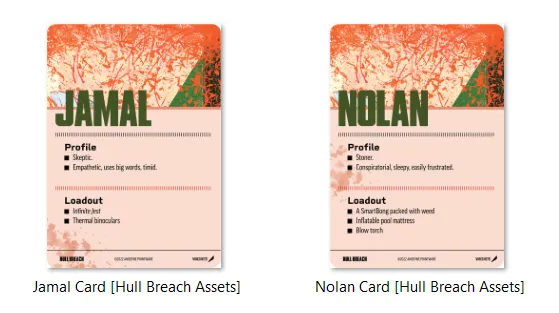
That's the solution! Take a card, put a name down, maybe some other points, slap them down in the middle of the table and immediately NPCs are easier to track - Not just that, but both GM and the Player interact with them more often, and interactions lead to building a relationship with them. Not just this, but by flipping the cards over you can also highlight who is in the scene to interact with and who is not, an act which also places focus on the cards for players to interact with. AND when a NPC died ripping up their card or scrawling a large DEAD in permanent marker is both very cruel and very fun. It proved so effective that one player sacrificed themself to save an NPC, and then the player started playing that NPC. It was one the best two-sessions of TTRPG gaming I've ever had (Supported by the excellent writing and layout of the adventure, the latter by Eric Hill)
Since then I’ve utilised this in every game I play with NPCs - from OSR games to Story Games, From Gmed to Gmless. Its a solution that works so well. My solo starforged game has a roster of NPC cards, sorted even in decks of where they live in the forge. When I bring a companion along for an adventure it feels impactful because I take the card and put it alongside my character sheet. When I ran a one player game of “when in rome” by Chris Airiau for mothership the NPC cards of the modules given team was core for keeping that game lively and social even when it was just a warden and one player. And in a group game of Mythic Bastionland NPC cards were important for establishing drama in the court, and then proved essential for the owl knight to rally a faction of knights against the wyvern - All what would have been once a nightmare to manage made inherently easier by these cards alone. I even ran a campaign of Hull Breach where the PCs were made from a collective of 42 NPCs in a worker Ship, each represented by a card and what department they were in.
And you don’t need to be fancy with it. I use these blank whiteboard cards and just scrawl a name and some visual features of the NPC on it, while you can also use Index Cards (like i do for Ironsworn) or sticky notes. While I can see other GMs taking a kick from designing/drawing elaborate NPC cards for their campaign.
But the question is, Why does this work so well? Well I think it relates back to my first blog post on Interactions
Of course the obvious thing is you are placing information down, outside of your head, but also in an easily accessible manner for all parties of the game. That's why it's stronger than just writing it in your GM notes. But also as tactility and interaction are important to "game feel" they are also important to game play. If you want players to interact with your NPCs, having a physical card at the table they interact with assists this. Fundamentally it’s a big blinking reminder that “NPC is here to talk to / bribe / romance / murder” for both GM and Player.
In fact it’s so simple I'm surprised nobody else talks about this? I can’t say i’ve seen it been in a game as advice (and I read a lot of games) nor is it ever given in rpg advice, even shockingly never in solo rpg advice either. Hell, Hull Breach does not even mention the NPC cards in the book, nor where they got the idea from. What gives?
So there you go, that's my advice. Blog Post done. BUT im designer pilled and rules maxing. How can designers use this same principle of information design and interactive cards for effective mechanics in their games? Let's look at some games that already do it:
FOR THE QUEEN:
For the queen 2e by Alex Roberts utilises this in its core gameplay, yet in a slightly opposite way ~ By providing a card with the image of the queen, no name or other information, it serves a point of interaction for other players, specifying genre or nature of the queen ~ it conveys information but in a more interpretive manner, perfect for a collaborative storytelling game. The art plays a similar role to the prompts, with the art sparking ideas for the responses. Not only that but it also co-ordinates players' understanding of the fiction (ie. Genre) even if each player has a different interpretation - A core part of TTRPG rules. The game would be different without the role of that art card, as simple and seemingly non-mechanical as it does.
MAUSRITTER:
Just like NPCs there has always been an issue with players ignoring their inventory ~ especially prevalent in DnD 5e and other games of its ilk, where a character’s sheet of powers and abilities and skills and feats trump a squashed box of unexplained items. (of course the issue here is one of lineage and vestigial mechanics). Many games work around this - either by game design, such as limiting the amount of powers so inventory becomes more important as is traditional in OSR dungeon crawlers, or by rejigging the character sheet so the inventory is more prominent, similar to the NPCs cards what you see prominently on your character sheet does affect what you interact with. One of my favourite inventory method combines both of these with Troikas 1-12 list, of which the order determines what you can pull out during a fight - Rolling 2d6, so anything at the top is easier to reach for than at the bottom a little piece of narrative mimicry with pulling items from a backpack. But when it comes to interaction the prize winner is Mausritter by Isaac Williams which uses cards. Arranging and managing your inventory is not only tactile its an interaction of greater importance, and as a result players use their items more, there is more utility gained from a jar of honey as a card than a scribbled line of text because it's prominently there: alongside its limited inventory size, it's engaging. Especially so for children, who find little cards inherently more memorable to take track off in a game than writing. But unlike the npc cards this wouldn't fit every game, it only makes sense for a game that cares for inventory organisation, yet it showcases how interactive tactile design can put focus on certain elements of the game and ensure player interaction both at the table and narratively. It's almost board game-esque in its style, similar to the card inventory of escape the dark sector (one of my favourites) or countless other games that use cards for inventory.
IRONSWORN:
Going back to Ironsworn by Shawn Tomkin (and its sister game Starforged), it utilises this principle in one of my favourite ways - Asset cards. I talked in my other blog post about how Ironsworn's dice mechanics invite interaction which adds a "gamey feel" to a solo ttrpg, and that's what asset cards do for easing cognitive load. In effect you don't need to recall everything your character does or can do to influence the situation because it's illustrated right in front of you at the table ~ Maybe in effect this is just me shilling my pro card game bias as a once former mtg fanatic (tho 6 years sober) and a recent preacher of the amazing hybrid narrative card game that is Earthborne Rangers (and how badly i want to see more games in that style). But hell, picking up an asset to say hey my training in archery lets me do this, just feels good, its fun, so is acquiring new assets in the form of the card.
ZOMBIE WORLD:
This isn't the only time we see cards in a PBTA inspired system , in Zombie World by Brendan Conway the game is played through cards for a quick no prep game. Characters are built in cards randomly placed at top of the character sheet similar to Ironsworn’s Assets, with elements of their past life hidden until a crucial moment when they are flipped for use. And they even have npcs cards in the form of the Population deck, used to create established relationships for the NPCs inside the apocalyptic Enclave. These npcs are a pillar of the game, entire narratives stemming around these etsablished relationships: One game the two NPCs were fighting over romancing the same woman, with them both exploring out into a zombie infested town just to receive a guitar for her. A plot line fabricated entirely by the players. I'd also be amiss to not mention the bite deck, which is not shuffled after each pull, creating an excellent source of tension as every pull gets you closer and closer to a bite, and that means death. Using interaction and tactility and the unique properties of cards to create tension similar to what ‘The wretched’ or ‘Dread’ does with a jenga tower.
CONCLUSION:
Fundamentally theres two points i want push here
NPC cards are helpful, everybody should use them, id like to see more people talk about them
Cards, and other tactile game pieces, can serve to ease cognitive load and provide more narrative interaction through physical interaction
This can be done at the table level with index cards, or scrap paper, or whiteboard cards, but it can also be served by designers: adventures can come with adventure card assets to print off like Hull Breach does, or games can be designed as boxsets with cards for play such as For the Queen [Although thats easier said then done especially for indie designers] ~ and hey coincidentally Quinn's Quest has just dropped a video on boxed games that relates to this, featuring other card based RPGs.
thank you for reading, now go play some games, make some npc cards, and designers steal from other analog games. forestoath/1000033051.webp)